10 March, 2009

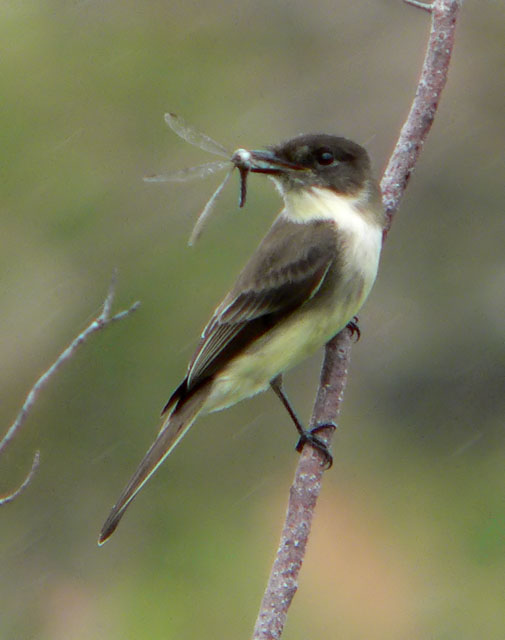
Eastern Phoebe heralds the arrival of spring....migrants are coming!!


Yesterday's spring preview brought many birds out of their winter silence and into singing yesterday. Eastern Phoebes have been calling recently, and brown thrashers, mockingbirds, eastern towhees, cardinals and American robins have been making themselves known as well with their spring songs. Keep your ears and eyes peeled for our first migrants. Cruising through Lost Cove yesterday in the back of a truck, I could almost swear I heard a Louisiana waterthrush. It was probably wishful thinking. I did see some of the first wild flowers out yesterday. I didn't ID them, but I think they were spring beauties (Claytonia virginica ). So keep your eyes to the trees and to the ground for spring, because it is coming soon!

(P.S. I didn't take that picture... I stole it from the internets)

19 February, 2009

Decision '09


To anybody who did not get my email:
A special meeting of the society has been called for Feb. 26 @8:00pm to hold elections for the 2009/2010 year, this is your one week notice, be there!

18 February, 2009

The spotted salamanders are out in force! Earlier tonight I bummed the bio-truck and hit up the ephemeral pond at the end of breakfield to check on these guys and found them out in droves, it was like catching fish in a barrel! Unfortunately, I forgot to return my SD card to my camera meaning that I only snapped off a couple of photos, none of which are great but I've tossed two up here anyway. Since there just chillin in the pond, they should stay there for a while, we'll discuss a salamandering expedition at tomorrow night's meeting.


Spotted salamander egg mass
.

The clearest picture of a spotted I got

31 January, 2009

Fernbank Museum of Natural History

November 22nd saw the Natural History Society in Atlanta, GA at the Fernbank Natural History Museum. In the 86ft high atrium is housed a 123ft long Argentinosaurus, among the largest dinosaurs ever found. The society will regress on Feb. 21st to veiw a special exhibit on modern paleontology opening in a week.
The great one.


Fellows veiw a perched Anhanguera


The crew hangs on for dear life
Awsome mask, picture taken just before we read the "no flash photography"sign

17 November, 2008

Previous meeting

1. Owling this Tuesday. We're thinking about heading out to the end of breakfield to listen for the barred owl, which is absolutely the most awsome sounding creature I've ever heard (two seemed to be fighting last Friday when Dan McCoy and I were out looking for salamanders)

2. Fernbank natural history museum this Saturday. The society will pay gas, meals, and admission. This will be open to the general campus (I'll get a cstudent sent out tomorrow) but I want y'all to have the opportunity to sign-up for the limited van-slots first. I'll post a sign up sheet somewhere is Spencer, probably (with his permission) outside of Dr.Haskell's office bright and early tomorrow morning, look for it or email me if you want a spot.

3. Some time near finals those of us at the meeting thought it would befun, because the tower room of Spencer looks like a war room, to hold agiant game of risk in the tower room of Spencer. Snacks and drinks will beprovided. Tentative event name is "screw finals party" (although more offensive wording was originally proposed)

4. Due to lack of useful facilities such as white boards and computerscreens, a vote was taken and the torian room was rejected for the meeting place next semester in favor of the tower room of Spencer.

5. Meeting dates for next semester will be the third Thursday of eachmonth, except January because we just get back two days before so we will meet the fourth Thursday of that month.

21 October, 2008

Marbled Salamander watch


It's that time of year again, the marbled salamanders will soon be frolicking in the ephemeral ponds and it is the sworn duty of the society to seek them out. Be on the alert the next couple of weeks for a society excursion following a good rain.

20 October, 2008

It Lives! The great Dr. Haskell has revived the old and faithfull blog. So time to post what has needed to go here for a while:
1. meetings: we have one more meeting this semester: Nov. 13th in the torian room.

More coming...
Sean McKenzie, Patrician

The BLOG lives again


Bufo says: watch this space

27 February, 2008

DARWIN DAY CELEBRATED!

On February 12th, the Society celebrated the birthday of a Prophet.
A massive celebration was underway late into the night at the Eco-House to celebrate the 199th birthday of Charles Darwin: Naturalist, Statesman, Philanthropist, Revolutionary.
The Society delved into pizza, soda pop, and David Attenborough documentaries to get the party going. The more avid followers of Darwin's life and times brought their personal barnacle collections. Others brought their earthworms. Enthusiasm was brought by all.
The Society can hardly wait for Feb 12, 2009, the big 2-0-0 anniversary of this leviathan of natural history.
Until next time:

D e s c e n d w i t h m o d i f i c a t i o n.

24 February, 2008

American Woodcock in Sewanee


Last Tuesday, the Society gathered at the airport to watch the peculiar mating habits of the American Woodcock, Scolopax minor. In Sewanee, this bird is most often encountered in late February at dusk in open fields such as the airport and the clear cut off of Breakfield.

The American woodcock has been made popular by writers such as Aldo Leopold who described the display of the male woodcock as the "sky dance" in The Sand County Almanac.

Check out the Cornell website to hear and read about this bird.

http://www.birds.cornell.edu/AllAboutBirds/BirdGuide/American_Woodcock_dtl.html

Photo from the Cornell website.

10 February, 2008

The Society Storms the Creation Museum

This weekend, a quorum of the Society made haste for the urban wasteland of lower Cincinnati to dive into a wholly other perspective of the natural world. The Creation Museum, located on the northern border of Kentucky, is a 28million-dollar fundamentalist Christian project that presents the history of earth and man's relation to it through a utterly literal interpretation of Genesis 1 and the Noah flood account in Genesis 9.

The Society poses for a candid photo at the foyer of the museum's entrance:
Good times were had by all: After an early early wake-up call, a hearty 5.5 hr drive, and a stopover at Hardee's for some breakfast grease (and ice cream for some), we perused the museum's exhibits, including a reconstruction of the Garden of Eden pre-fall (penguins, leopards and vegetarian Tyrannosaurs living peacefully with Adam and his strikingly Barbie-esque Eve), an animatronic re-enactment of the building of the ark, and mutlimedia explanations for the 6-earth day creation, the distinctly layered geologic and fossil record, and the reasons for painful child-bearing and carnivorous animals. It was widely agreed upon by all attended that the best display was a baby triceratops with a saddle on its back (for use by Adam and Eve in the Garden):Keep on the look out for a more in-depth presentation of our inquiry into this museum of the supernatural history of life on earth, coming soon.

17 October, 2007

New Cave!

Last Sunday, a crew of seven explored a small cave below Point Disappointment. A narrow passageway led to a spacious room and we explored two passages leading from this room, squeezing through narrow tunnels. The crew found two bats, two slimy salamanders, assorted spiders, and cave crickets.

Want to check it out? Park at the old waste water treatment plant and walk down Depot Branch about a mile till you find a cave opening on your right. For you geologically minded folks, the cave opening is 50 meters downstream from the disconformity between the Mississippian Limestone and Pennsylvanian sandstone.

-Elspeth
Dearest Bio-geeks,
It is an honor to announce the results from a nigh-spontaneous herping
quest that occurred yestereve.

Locale: Ephemeral Pond, end'o'Brakefield
Questers: EM Keen, DA McCoy, EM Iralu
Query: Caudata.

RESULTS:
106 Marbled Salamanders (Ambystoma opacum).
106. M a r b l e d - freaking - s a l a m a n d e r s .
In a single ephemeral pond.
In a 40-minute search window.
Most were in mating pairs.

CONCLUSION:
The plateau is teeming. t e e m i n g .


01 October, 2007

Fuersalamander aus dem Odenwald


Hellö naturalisches historianisen!

Here in the fame forests of Southwestern Germany, sick sick sick animals abound. I must say that it is a lovely place to be, this Odin's forest. I must tell you of a salamander, the Feursalamander of legend. This is a most astonishing beast, beyond all doubt. It is fire elemental, it is poisonous, it is on coats of arms, and it is ovoviviparous. The thing discharges little salamander pollywogs without laying eggs at all. The poison glands behind its eyes can blind you if squirted sharply, and the poison inhibits mold and fungus from growing on the burning skin of the knave.
I encountered this specimen while taking a casual garden stroll. One of only two salamander species in the area, it survives here because it is made of magic thread that never burns.
I considered brewing a potion of invinceability with this juicy ingredient, but I couldn't bring myself to remove any of his adorable toes.
best to you all

Herr B.L:Pädgett, Patron-at-Large.

http://en.wikipedia.org/wiki/Salamander_%28legendary_creature%29

25 September, 2007

Society Meeting Dates, Fall Semester 2007

The Society will rendezvous in Gailor 202 every other Tuesday of this semester.
These dates include:

September 25
October 9
October 23
November 6
November 20
December 4

These meetings will be used to share current events in natural history on the plateau, disclose financial information and fiscal activity of the Society, plan upcoming trips, bathe in the glory of recently completed outings, and highlight scientists and/or phenomena of the natural sciences.
Everyone and anything is welcome to attend.

Yours,
EM Keen, Patrician

19 September, 2007

Natural History of the Cross

In the late summer, masses of moths and other flying insects rendeszvous under the scorching spotlights of the University Memorial Cross to partake in a nightly frenzy of nocturnal feeding and sexing. The Society converged on this entomobananza earlier this week under a waxing crescent moon. Geometridae aside, fellows reported findings of lacewings galore, as well as a phenomenal close relative: the spectacular wasp mantisfly (Climaciella spp.), a Neuropteran also related to ant lions. Ground-dwelling coleopterans, featuring a unprecedented turnout of weevils of every sort, as well as hemipterans and arachnids congregated along the grass near the iron fencing of the memorial. The stars, featuring Jupiter rising abovethe Western horizon, were magnificent. Large members of both Orthoptera's Tettigoniidae and Acrididae were huge hits, especially when one particularly adventurous hopper tried to climb inside Carey Donald's ear.

THE FEATURE PRESENTATION OF THIS NATURAL HISTORY EVENT: Chiroptera. Bats. These placental fighter jets were patrolling the Cross lights on the hunt for inattentive bugs. When hunting, these bats dove and dipped in spectacular showcases of aggressive attack maneuveurs- stunning rolling vortexes as they killed in cold blood - truly formidable displays of derring doo. When we could quiet the jubilated cries of the fellows, we were able to hear the bats clicking their internal sonar-guns over our heads as the raced by.

What a night for Natural History.
Yours,
EM Keen, Patrician
Pictures by Kate Cummings

31 August, 2007

The Voyage of the Starling

Greetings, naturalists.
It is indeed a new semester, chock-full of time and opportunity. Thus begins a historic several months in the celebration of the natural history of Tennessee's tableland and all other things jaw-dropping.
The Society kicked off this school year's exploits with a rendezvous on the windy waters of Woods Reservoir for a sunset voyage of paddle and binocular. We intrepidly canoed out to a small nitrogen-waylaid island of ambitious trees that serve as a rookery for the noisiest and most farty of wading birds and their swarming tagalong passerine friends. Bird count for the expedition includes, but is not limited to:
Yellow-crowned night heron
Cattle Egret galore
Little Blue Heron
Great Egret
The notorious Mr. Mallard
Red-Winged Blackbird
Osprey (displaying fabulous diving skills)
Double-crested cormorants
Starlings, thousands of starlings.

Perhaps the most glorious sight of this sunset-drenched canoeing trip was the morphous amoeba-like swarms of flying starlings that would darken certain blocks of sky with staggering flock-shapes and derring-doo.

On a non-ornithological note, the entirety of the drive back took place within the usual summer-mist of lepidopterans (most notably of the geometridae), neuropterans, and other nocturnal pterogytes of the warm August fields. The insects are out in full force, especially after our recent rains. The SNH Society has begun to respond in kind to the climatic and ecological events at hand. Now is the time to spread wings and fly, to empathize with bird and moth and get OUT THERE. Here's to a new semester!
Yours,
EMKeen, Patrician

30 June, 2007

Fiji: Volcanoes & Chelicerates!


Island Biogeography: a fascinating subject, and what better place to study it than in the archipelago of the Republic of Fiji?
Cohort BL Padgett and I took the Subduction Recon Team out of the frosty subantarctic to the sea-breezed equatorial isles of the South Pacific this last week. Fiji is a collection of volcanic islands, calcareous paleo-reef mounds and subducted & uplifted oceanic crust.

It truly is another world.
Pumice, a not-at-all dense igneousvolcanic rock, FLOATS between volcanic and reef-born islands that are so young and rumbly that their flora are still dominated by early successional shade intolerant species. Being an archipelago of isles that vary in origin, size and topography, it perfectly elucidates the principles & mysteries of island biogeography...plus, it's tropical paradise.
Most islands have no standing fresh water and the resources and living space are of such paucity that dispersal and establishment of biota on these isles is a rare event, but there is one phylum of Animalia that has perfected such acts of dispersal heroism: Arthropods. Namely, the Insecta, Chelicerates and Myriapods. Flocks of Lepidoptera, man-eating spiders, and centipedes that tunnel through the sand and bite Luke's feet. Here are a few pics of some specimens we encountered.
The Fiji isles are also an example of another phenomenon associated with biogeography on small islands: the trend towards gigantism. Both these spider species were the size of my palm. We found a web spun by the species with the white abdomen that measured literally 20 ft across! Perhaps the best example of this trend towards gigantism is the Fiji Walking Stick, one of the largest insects in the world (over a foot long!!!). Sadly, we didn't encounter this fella. Oh well, it's just an excuse to go back and find it.
Oh, Padgett and I also made a raft (see bottom pic).

This concludes the Oceania posts. Oceania is truly a mystery, and it holds the key to much that we do not yet understand about our natural world. Here's to Wombats, Moas and Giant Walking Sticks, and all things historically natural!

EM
"To live would be an awfully big adventure"