Ornithorhynchus and Tardigradia
28 February, 2011
Salamandering 2011
For the solemn purpose of leaving record and knowledge for the sake of posterity and furthering of knowledge, we undertake here to leave written accompt of the salamandering exploits of this spring, so that others may follow in our drenched boots. Due to unseasonable warmth and outlandish amounts of early rain, the salamanders of the genus Ambystoma, species maculatum, did undertook an exodus from their burrows on or immediately before the 20th of February, this two-thousand and eleventh year of our lord Jesus Christ. The temperature on that day had reached 70 degrees Fahrenheit, and had been in the 60s the entire week before hand, with the last frost being exactly one week prior. The rain that evening had been scarce, with only a couple of strong bursts, but this was apparently sufficient to drive the salamanders from their burrows, leading me to the conclusion that the temperature is the driving determiner of A. maculatum migration timing. The leaf litter was moist on top but by no means saturated with water. We that night at the Brakefield Rd. pond observed 140 salamanders in a brief span of time, mostly in clumps of 10-20 around egg masses or clumps of spermataphores. The following week we did return to the same pond, finding only four spotted salamanders and four mole salamanders (Ambystoma talpoideum). All signs of spermataphores where absent but many egg masses were to be observed. The next night we traveled to a small pond near Airport Rd., having sought the large pond but being unable to find it on account of fog. In this pond, roughly 5m x 5m, we did observe one clump of spotted salamander eggs but none of the organisms proper. Two mole salamanders were observed, of a color morph not previously observed by myself (Ornithorhynchus)- being of a dark grey color with lighter grey speckling rather than the dark brown with lighter brown mid-line usually observed at the Brakefield Road pond. Also observed that night were a plethora of minuscule arthropods, seemingly like springtails, on the surface of the water, especially partially submersed logs- accompanied by one very lost earth worm with no visible route to attain shore. These observations we solemnly confide to the society this 28th day of February, 2011, in eternal trust of this moste prestigious blog, for everlasting keepsake and source of knowledge.


01 April, 2010
Day 3 (13 March 2010): Canoeing the Okeefenokee
Yesterday we decided that since most of this place was underwater anyway, the best place from which to get a sense of the park would be the seat of one of those ungainly silver canoes beached on the canal. We started our journey at eight o'clock, in #17 and #18. The going was easy, the first few miles, up to Billy's Island (or as the sign says, Billys Island). We felt like creations of Robert Louis Stevenson disembarking the Hispanola as we landed, amid cool shade and dense vegetation, in total isolation. The only signs of human life were some hundred-year-old rusted-out metal vats strewn across the landscape. As were about to retake the boats, a juvenile hawk mewing at the top of a tree arrested our attention. He clearly wanted his mother, and so did we.
Next, northward to Minnie's Lake, where the wide canal narrowed and became tortuous to navigate, which afforded much opportunity for learning to manage the canoe as we shot and weaved through tight turns and openings barely large enough for our boat to pass through. We had to push our oars off the cypress tress to keep from crashing. This swamp, at least right now, is cowbird heaven; we saw more cowbirds than alligators, and we saw twenty-five alligators today. Corinna the park naturalist says that one can estimate an alligator's total length by the size of its head: take a ruler and measure the distance between the creature's snout and its eyes in inches, and you have the total length of the animal in feet. Using this method we determined that most of the alligators we saw were 6-8 feet in length, and a few slightly larger.
The wind and waves were against us on our return to the canal. When we exited the dense canopy of the winding northern way up to Minnie's Lake and returned to the main waterway, the wind broke upon us from the right with surprising force, making it difficult even to turn the boat into the wind. If we paddled even moderately we lost ground against the current, and the shifting wind kept turning the boat's nose off course. When we finally landed at the dock, we were exhausted and sore, but very satisfied, campers.
Stephanie led another night hike on the boardwalk this evening, complete with periodic listening exercises. These quiet times I cherished more than any we had on the trip. A listening exercise is sort of like turning off a bright light on a very dark night; just as your eyes slowly become accustomed to the darkness they are able to make out more of the landscape and skyscape, so your ears, as they become accustomed to quiet, are able to pinpoint more and more sound sources, even very faint and remote. The sounds swirl together in one's head, and one orchestrates them unconsciously until they make a kind of coherent music with its own distinctive character, maybe peaceful, maybe ominous and foreboding.
Yesterday we decided that since most of this place was underwater anyway, the best place from which to get a sense of the park would be the seat of one of those ungainly silver canoes beached on the canal. We started our journey at eight o'clock, in #17 and #18. The going was easy, the first few miles, up to Billy's Island (or as the sign says, Billys Island). We felt like creations of Robert Louis Stevenson disembarking the Hispanola as we landed, amid cool shade and dense vegetation, in total isolation. The only signs of human life were some hundred-year-old rusted-out metal vats strewn across the landscape. As were about to retake the boats, a juvenile hawk mewing at the top of a tree arrested our attention. He clearly wanted his mother, and so did we.
Next, northward to Minnie's Lake, where the wide canal narrowed and became tortuous to navigate, which afforded much opportunity for learning to manage the canoe as we shot and weaved through tight turns and openings barely large enough for our boat to pass through. We had to push our oars off the cypress tress to keep from crashing. This swamp, at least right now, is cowbird heaven; we saw more cowbirds than alligators, and we saw twenty-five alligators today. Corinna the park naturalist says that one can estimate an alligator's total length by the size of its head: take a ruler and measure the distance between the creature's snout and its eyes in inches, and you have the total length of the animal in feet. Using this method we determined that most of the alligators we saw were 6-8 feet in length, and a few slightly larger.
The wind and waves were against us on our return to the canal. When we exited the dense canopy of the winding northern way up to Minnie's Lake and returned to the main waterway, the wind broke upon us from the right with surprising force, making it difficult even to turn the boat into the wind. If we paddled even moderately we lost ground against the current, and the shifting wind kept turning the boat's nose off course. When we finally landed at the dock, we were exhausted and sore, but very satisfied, campers.
Stephanie led another night hike on the boardwalk this evening, complete with periodic listening exercises. These quiet times I cherished more than any we had on the trip. A listening exercise is sort of like turning off a bright light on a very dark night; just as your eyes slowly become accustomed to the darkness they are able to make out more of the landscape and skyscape, so your ears, as they become accustomed to quiet, are able to pinpoint more and more sound sources, even very faint and remote. The sounds swirl together in one's head, and one orchestrates them unconsciously until they make a kind of coherent music with its own distinctive character, maybe peaceful, maybe ominous and foreboding.
17 March, 2010
Day 1: March 11, 2010... Arrive in Okeefenokee Swamp
Our expedition began on a cloudy Thursday in Sewanee. Four members of the Sewanee Natural History Society, Cyclocosmia, Egretta, Pipilo, and Benzene piled into our little vehicle called Squeaky to begin the adventure of a lifetime. Our first stop was the Okeefenokee Swamp, a 6500 year old (wikipedia) wetland about 120 miles from the Georgia coast. Along the way, Pipilo discovered some really cool granite rocks on the side of the highway. We didn't reach the park gates until after dark, and were lucky that we made it safely to our campground site since we were attacked by several crazed animals on the park roads. First a hawk came out of no where and hit the front of Squeaky. Five minutes after this incident, a deer slammed into us, but luckily it didn't hit us hard because Squeaky had almost come to a complete stop. Once we made it through the maze of suicidal animals and reached our campground location we spotted a group of foraging raccoons. We then worked to set up our tents but while doing so, I stepped on a mound of Formicidae and was immediately covered by these vicious little hymenoptera. My body responded to this attack with a allergic reaction and I soon swelled up like a member of the Solanaceae family. I was fine by the next morning, however. Overall, we had quite an interesting beginning to our naturally historical journey.
SNHS Spring Break Trip 2010
Hello all Natural Historians,
Four intrepid members of the Sewanee Natural History Society embarked on an awesome expedition from March 11 to March 22, 2010. The following accounts are daily diaries of our adventure posted by our fearless explorers. Please read on.
Cyclocosmia, matrician
16 September, 2009
Tales of the Roving Fellow IV

I've died and gone to a David Attenborough film! I'm here at Finca La Selva, the famous OTS research station at the lower end of the Sarapiqui river. I've been here barely 24hrs and seen (get ready...): Howler monkeys, spider monkeys, pecaries out the wazoo (like St. Cat's pigs), lattice tailed trogon, montezuma oropendula, dozens of other beautiful but unidentified passerines and hummingbirds, iguanas, central american whiptails, bronze backed climbing skinks, a dink frog (common and somewhat boring, but included for sake of comprehensiveness), cane toad (same), numerous small as-of-yet unidentified lizards, a eyelash pit viper (yeah, open y'alls mouths and drool; I'll come back to this...), golden orb weaver spiders (biggest web-weaving spiders around, much larger than those in the states), some ctenid spiders and huge lycosids, grasshoppers the size of my hand, moths the size of my face, fish, flowers, vines and myriapods- in short paradise. Been having trouble with camera batteries so all I've got to put up is one Eyelash pitviper pic, but being an eyelash pit viper I think it's awesome enough by itself. Saw this guy on our orientation walk barely a couple of hours ago; I'm pretty sure my life is now complete (though I would like to see a jaguar before I go). Oh, forgot to mention the beyond awesome members of Formicidae, specifically leaf cutter ants and bullets ants. Leaf cutter ants are all over the place here, busily chopping away at the understory leaves. They form long trails of bare dirt across the forest floor and busily carry leaves along them to feed the fungus in their mounds (see video). Bullet ants are about 2.5cm long, the hugest ants I've ever seen. They can both bite and sting, and get their name from the pain associated with the latter of these two. Anyway, I'm in an awesome rainforest and frankly have better things to do that sit behind a computer, so I'm signing off here.
Your's in bioawe (bio-awe),
Ornithorhynchus, Roving Fellow

Your's in bioawe (bio-awe),
Ornithorhynchus, Roving Fellow

Eyelash palm pitviper
Leafcutter ants
10 September, 2009
Tales of the Roving Fellow III

Tomorrow I bus down to Cuerici for a week, where I will lack internet connection, so I though I'd better update the society before I left. Biodiversity here continues to be awesome, and I have now seen two sp. of Costa Rican primates! The first was shortly after my last post: while heading down to the Las Cruces futbol (soccer) field to throw a frisbee around, we stumbled across a pair of white faced capuchins hanging out on the border of the forest. Fun creatures, didn't seem particularly afraid of humans. Even cooler however, was my second primate spotting. While hiking up a mountain in Las Alturas farm (a killer hike, by the way; 700m elevation, but awesome view from the top) we ran into an entire troop of the critically endangered spider monkeys.
04 September, 2009
Photo Contest!
We are having three photo contests this year. Our first contest will be due at our Octobor meeting. You need to take five photos of any type of arthropod and identify it at least to its order. All participants will receive a prize, while the winner will receive a larger prize.
Tales of the Roving Fellow II

Veiw of Panama

Inside the Rainforest

Gaestreus mushroom

Aguiti in the garden
 Writing from the Las Cruces field station and botanical gardens, Costa Rica. Awesomeness in the tropics! The field station sits at a 1,200m elevation in a premontane tropical wet forest near the Panama border. I'm absolutely sure that I've more than doubled the amount of vertebrate biodiversity I've seen in my life in the span of little more than a week. Currently at the station is none other than great and revered founder Leighton Reid, who took several of the more hard core birders (including myself, of course) out on a birding walk last Monday in which we saw or heard 77 sp. of birds. Mammals have been scarce, but I have seen agoutis, coatis, either a kinkajou, tayra, or small puma (it was dark, only an outline and eyes were visible), and, funny story, a german shepherd that was mistaken for a jaguar. Quick facts: Costa Rica has 4% of terrestrial diversity in 0.03% of land area. As far as birds go, Costa Rica alone, roughly the size of Virginia, has almost as many bird species as the entire North America. Lastly, I'm positive that when I hang out my towel to dry, it actually gets more wet (slightly exaggerating there of course, but the humidity in the rainy season is intense!)
Yours soggily:
Ornithorhyncus; Roving Fellow
28 August, 2009
Note about Canopus use
For those of you who are new members, the Sewanee Natural History Society possesses a trunk known as The Canopus. This trunk contains many cool items such as kill jars and a bunch of really awesome DVDs. In previous years, The Canopus was left unopened, free of access to all members. However, due to the loss of many of our DVDs we are keeping it locked this year. Access for items in it many only be obtained at meetings. However, if you really want an item you can also contact either myself (x2003) or Microraptor/Tardigrade, matrician ((x2351). Do not be afraid to ask. We encourage the use of The Canopus.
24 August, 2009
Journey of the Roving Fellow I

 Greetings to the society! I'm jetting out of Charlotte, NC for San Jose Costa Rica in about an hour, where I will be spending the semester steeped in the bioawesomeness of the tropics. As the officialy ellected "Roving Fellow", I will keep ye ol' blog updated as often as possible. In the next few months I will hop around five field research stations, in order Las Cruces, Cuerici, La Selva, Monteverde, y (and) Paloverde, with a stop back in San Jose in between for cultura y lengua. Like I said, I'll keep y'all posted.
Sean McKenzie, Ornythorhynchus and Roving Fellow
25 March, 2009

10 March, 2009
Eastern Phoebe heralds the arrival of spring....migrants are coming!!
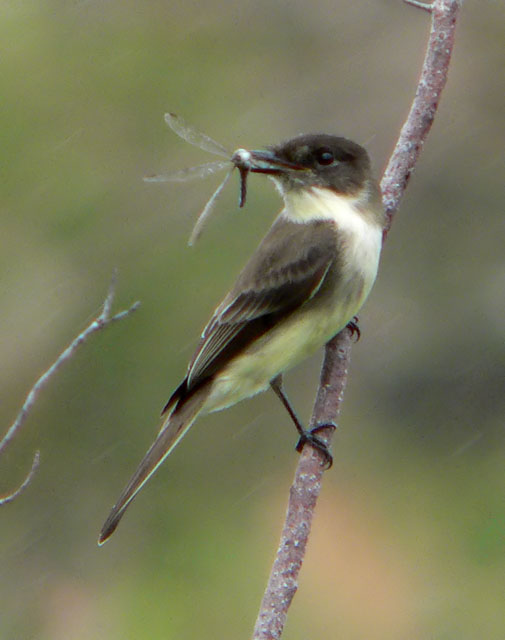
Yesterday's spring preview brought many birds out of their winter silence and into singing yesterday. Eastern Phoebes have been calling recently, and brown thrashers, mockingbirds, eastern towhees, cardinals and American robins have been making themselves known as well with their spring songs. Keep your ears and eyes peeled for our first migrants. Cruising through Lost Cove yesterday in the back of a truck, I could almost swear I heard a Louisiana waterthrush. It was probably wishful thinking. I did see some of the first wild flowers out yesterday. I didn't ID them, but I think they were spring beauties (Claytonia virginica ). So keep your eyes to the trees and to the ground for spring, because it is coming soon!
(P.S. I didn't take that picture... I stole it from the internets)
19 February, 2009
Decision '09

To anybody who did not get my email:
A special meeting of the society has been called for Feb. 26 @8:00pm to hold elections for the 2009/2010 year, this is your one week notice, be there!
A special meeting of the society has been called for Feb. 26 @8:00pm to hold elections for the 2009/2010 year, this is your one week notice, be there!
18 February, 2009
The spotted salamanders are out in force! Earlier tonight I bummed the bio-truck and hit up the ephemeral pond at the end of breakfield to check on these guys and found them out in droves, it was like catching fish in a barrel! Unfortunately, I forgot to return my SD card to my camera meaning that I only snapped off a couple of photos, none of which are great but I've tossed two up here anyway. Since there just chillin in the pond, they should stay there for a while, we'll discuss a salamandering expedition at tomorrow night's meeting.

Spotted salamander egg mass
.
The clearest picture of a spotted I got
31 January, 2009
Fernbank Museum of Natural History
November 22nd saw the Natural History Society in Atlanta, GA at the Fernbank Natural History Museum. In the 86ft high atrium is housed a 123ft long Argentinosaurus, among the largest dinosaurs ever found. The society will regress on Feb. 21st to veiw a special exhibit on modern paleontology opening in a week.
 Fellows veiw a perched Anhanguera
 The crew hangs on for dear life
The great one.
 Fellows veiw a perched AnhangueraThe crew hangs on for dear life
Awsome mask, picture taken just before we read the "no flash photography"sign
17 November, 2008
Previous meeting
1. Owling this Tuesday. We're thinking about heading out to the end of breakfield to listen for the barred owl, which is absolutely the most awsome sounding creature I've ever heard (two seemed to be fighting last Friday when Dan McCoy and I were out looking for salamanders)
2. Fernbank natural history museum this Saturday. The society will pay gas, meals, and admission. This will be open to the general campus (I'll get a cstudent sent out tomorrow) but I want y'all to have the opportunity to sign-up for the limited van-slots first. I'll post a sign up sheet somewhere is Spencer, probably (with his permission) outside of Dr.Haskell's office bright and early tomorrow morning, look for it or email me if you want a spot.
3. Some time near finals those of us at the meeting thought it would befun, because the tower room of Spencer looks like a war room, to hold agiant game of risk in the tower room of Spencer. Snacks and drinks will beprovided. Tentative event name is "screw finals party" (although more offensive wording was originally proposed)
4. Due to lack of useful facilities such as white boards and computerscreens, a vote was taken and the torian room was rejected for the meeting place next semester in favor of the tower room of Spencer.
5. Meeting dates for next semester will be the third Thursday of eachmonth, except January because we just get back two days before so we will meet the fourth Thursday of that month.
2. Fernbank natural history museum this Saturday. The society will pay gas, meals, and admission. This will be open to the general campus (I'll get a cstudent sent out tomorrow) but I want y'all to have the opportunity to sign-up for the limited van-slots first. I'll post a sign up sheet somewhere is Spencer, probably (with his permission) outside of Dr.Haskell's office bright and early tomorrow morning, look for it or email me if you want a spot.
3. Some time near finals those of us at the meeting thought it would befun, because the tower room of Spencer looks like a war room, to hold agiant game of risk in the tower room of Spencer. Snacks and drinks will beprovided. Tentative event name is "screw finals party" (although more offensive wording was originally proposed)
4. Due to lack of useful facilities such as white boards and computerscreens, a vote was taken and the torian room was rejected for the meeting place next semester in favor of the tower room of Spencer.
5. Meeting dates for next semester will be the third Thursday of eachmonth, except January because we just get back two days before so we will meet the fourth Thursday of that month.
21 October, 2008
Marbled Salamander watch

It's that time of year again, the marbled salamanders will soon be frolicking in the ephemeral ponds and it is the sworn duty of the society to seek them out. Be on the alert the next couple of weeks for a society excursion following a good rain.
20 October, 2008


10 September, 2008
Subscribe to:
Posts (Atom)